
WHAT HAPPENS WHEN AN OFFICER KNOWS THE NEIGHBORHOOD?
I recently sat down with Dick Daley, a retired Madison police officer and former president of the Madison police union.
Dick was born in Madison and has watched this city change over many decades. But one part of our conversation stayed with me: what it meant to be a beat cop.
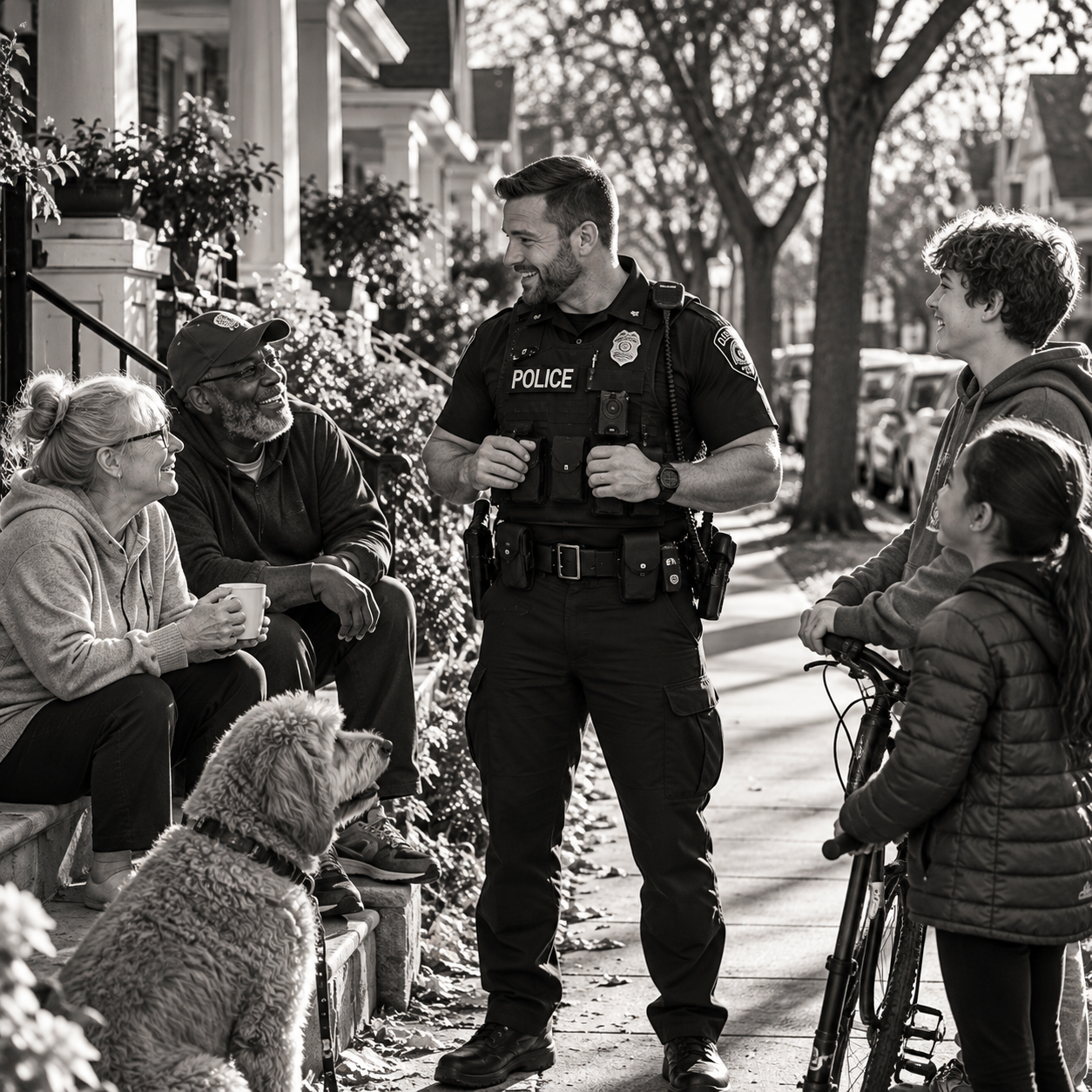
Dick spent time walking a beat on Madison's South Side.
The way he described it, the job wasn't simply responding when something went wrong.
You were there.
You knew the neighborhood.
People knew you.
You talked to residents. You spent time in the community. You knew the people, the businesses and the rhythms of the area you were responsible for.
Over time, that kind of policing evolved into what became known as neighborhood policing—officers assigned to particular areas who could become more connected to the communities they served.
That got me thinking.
WHAT DO WE LOSE WHEN EVERYTHING BECOMES A RESPONSE?
There are good reasons policing changed.
Dick talked about one of them.
If an officer was walking a beat and an emergency happened somewhere else, getting that officer to the scene quickly could be difficult.
But solving one problem can sometimes create another.
If officers spend more of their time moving from call to call, how much time is left to simply know a neighborhood?
How often does an officer meet someone before that person's worst moment?
How often do residents get to know an officer when nobody is being arrested, nobody is in crisis and nothing has gone wrong?
Those relationships matter.
Trust is difficult to build during an emergency.
It is much easier to build it beforehand.
MAYBE THE QUESTION ISN'T OLD POLICING OR NEW POLICING
I'm not interested in recreating Madison policing from fifty years ago.
Madison is different.
Policing is different.
Technology is different.
The demands on officers are different.
Our expectations of public safety are different.
But there may be something worth recovering from the basic idea behind the beat cop:
Presence. Familiarity. Relationships.
The question is how we accomplish that today without sacrificing the ability to respond quickly when someone needs help.
Maybe bicycles or e-bikes can play a role in some neighborhoods.
Maybe neighborhood officers can spend more time outside of vehicles.
Maybe CARES can respond to more calls that don't require a police officer, creating more capacity for officers to be present in neighborhoods.
Maybe there are other approaches we haven't considered yet.
I don't know the answer.
But I think it's worth asking the question.
TRAINING WAS ANOTHER LESSON
Dick also talked about changes in police defensive-tactics training during his career.
What struck me wasn't a particular technique.
It was something much simpler.
He said the newer methods worked well for the officers who practiced them.
That matters and it's something I've said since the Ruiz shooting.
Learning something once isn't the same as knowing how to do it under pressure.
Whether we're talking about communication, de-escalation, defensive tactics or anything else we expect an officer to use during a difficult encounter, we should be asking:
How often is it practiced?
Does the training carry over into real situations?
How do we know?
Those are outcome questions.
And I think we should be asking them throughout City government.
THE VALUE OF TALKING TO PEOPLE WHO WERE THERE
One of the reasons I'm having these conversations is that reports and statistics can tell us a lot, but they can't tell us everything.
People carry institutional memory.
A retired officer can tell us why something changed.
A neighborhood resident can tell us how that change felt from the other side.
A current officer can tell us what works differently today.
A community advocate may see something all three are missing.
We don't have to agree with every person's interpretation of the past to learn from their experience.
That's the point of the conversation.
Madison doesn't need to go backward.
But sometimes understanding what we stopped doing can help us think differently about what we should do next.
